
The Environmental Impacts of the Crisis in Gaza
- lynxrufus716
- Dec 27, 2024
- 6 min read

Updated: Jan 4, 2025
By Alicia Szczesniak
Perhaps you’ve heard it chanted in the streets. Maybe you’ve seen it plastered on walls. “From the river to the sea, Palestine will be free”. Since October 7th, 2023, the western territory of Palestine, Gaza, has been under constant bombardment from the Israeli military. It has led to irreparable damage and loss of life. But, the crisis did not start then, nor will it stop when the smoke clears.
Israel was established as a country in 1948, after waves of Jewish immigrants migrated to the region from Europe. The land was previously under British rule, and occupied by Palestinian Arabs. However, with their declaration of independence, 77% of the occupied land, including most of Jerusalem, was soon under Israeli control. Subsequently, many Palestinians fled the violence, and those who remained had to live their lives in their remaining territory.
In 1982, Israel invaded Lebanon in an attempt to eliminate the Palestine Liberation Organization (PLO). Despite promises of safety for refugees left behind, massacres took place, leading to the deaths of between 2,000-3,500 Palestinians and Lebanese citizens. In 1987, an intifada, or revolution, occurred against Israeli occupation. The intifada lasted until 1993, killing 100 Israeli soldiers and 1,000 Palestinian rebels in the process. The Oslo accords put a stop to it, where Israel accepted the PLO as Palestine’s representative, and Palestine accepted Israel’s right to exist and denounced armed resistance.
However, many groups, such as Hamas and Islamic Jihad, saw this as a sign of surrender to Israel’s land seizure 45 years earlier. This combined with increasing frustration towards Israel’s disregard for the Oslo Accords ultimately led to a second intifada, sparked by the invasion of a mosque by IDF soldiers in 2000. The second intifada would last until 2005, and would lead to at least 4,973 Palestinian deaths. After the intifada’s end, Israel would continue to expand into Palestinian territory.
All this leads up to October 7th, 2023. The government group of the territory of Gaza, Hamas, launched an assault on Israel, killing 1,200 civilians. As a result, Israel retaliated, and began bombarding Gaza with military assaults and occupation. One year on, over 44,000 Palestinians have been killed, and countless more have been injured, displaced or gone missing. The suffering and loss of life is tragic, and the impact spreads far beyond the people of Palestine.
The environment of Gaza has been severely damaged from the bombardment, and the effects are extending beyond the enclave’s borders.
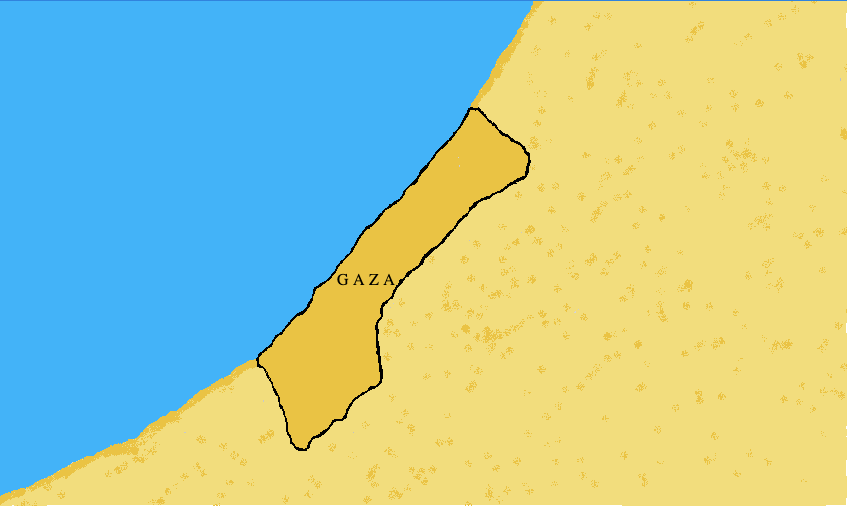
Gaza is a tiny territory bordering the Mediterranean Sea, measuring at just 360 square kilometers, or 139 square miles, and a population of over 2 million people. The small plot of land was already severely crowded, and the bombardment has taken the heavily urbanized land and reduced it to rubble. This has happened to such a degree that the UN has declared that the debris generated by the conflict is 14 times larger than all the conflicts of the past 16 years combined. Bear in mind, all of this occurred in just one year.
As of July 2024, over 42,000,000 metric tons of debris have been generated, or 114 kilograms for every square meter in the Gaza strip. Much of this comes from the destruction of buildings. A report from Reuters shows that 163,778 structures have been damaged, equating to a number roughly three times that of the buildings in Manhattan.
The destruction of the man made structures in Gaza has also led to the collapse of the sewage system within the Gaza strip. This has allowed for raw sewage and wastewater to flow out into the Mediterranean Sea.
Wastewater can greatly impact the health of the marine environment. Sewage is loaded with pathogens that can enter the systems of organisms. Prior to the conflict, a large number of Gazans relied on fishing as both a source of food and a source of income, even with Israeli rules preventing them from going far out to sea. However, as a result of the conflict, many Gazans have had to collect any organisms that venture close enough to shore to feed themselves and their families. But, the wastewater that has contaminated the Mediterranean Sea has also contaminated the few organisms left to eat, putting Palestinians at an even higher risk of disease.
Alongside this, wastewater can allow for algae to grow at a fast rate. Wastewater is packed full of nutrients that are easily digestible by algae. The algae multiplies quickly, forming a harmful algal bloom (HAB). HABs are sometimes toxic, but a large amount are nontoxic. However, even nontoxic HABs pose a major threat to the environment. They can deplete the oxygen in a marine environment, ultimately killing any organisms in the water column. This also happens by blocking out the sun, preventing plants from photosynthesizing and smothering corals.
But, the Mediterranean Sea is not the only piece of the environment being affected by the crisis. The Wadi Gaza is under threat right now, and the effects could be disastrous.
The Wadi Gaza is a large wetland along the coast. The wetland provides a home to a wide range of organisms, most notably a diverse array of birds. Gaza sits at the junction of Africa and Eurasia, making it a prime spot for migrating birds to stop. These birds include flamingos, quails, storks, herons and the Palestine Sunbird, the country’s national bird. Sewage has inundated the wetland, making it a terrible place for birds to live. While researchers cannot enter Gaza to look at the damage done by the conflict, it is reasonable to assume that it has left the land in dire condition.
But wastewater is not the only cause of environmental catastrophe in the Gaza strip. The tunnels underneath the enclave could spell disaster. The tunnels have been used for years as a means to smuggle goods into Gaza, but have been expanded upon by Hamas for military purposes. The network of tunnels is extensive, with Hamas claiming that they had built over 310 miles of them. They are often deep underground, and can get close to the Coastal Aquifer Basin, the source of water for most of Gaza.
One way that the IDF has attempted to eliminate these tunnels is through flooding, often by seawater. While the IDF assures that these floods are targeted and will not affect the groundwater, many researchers fear that this may not be true.
The tunnels often have a floor made of nothing but soil, meaning that any water that flows through the tunnels will seep into the aquifer, which is already contaminated by seawater. There has been debate amongst experts as to whether or not seepage from the tunnels would significantly affect the aquifer, and it often boils down to which tunnels are being flooded by the IDF, as the inundated tunnels have not been confirmed.
The constant bombardment from munitions has also led to a leakage of toxic chemicals and debris into the surrounding environment.
One example of this artillery comes in the form of white phosphorus. Shortly after October 7th, videos began to circulate on social media of Israeli jets flying over Gaza, dropping shells full of white phosphorus onto the city.
White phosphorus is an incendiary, meaning it is used as a weapon to start fires. The chemical ignites immediately upon coming into contact with oxygen. This can cause severe chemical burns for anyone who is nearby, sometimes burning through skin down to the bone, alongside a variety of other adverse symptoms.
But, white phosphorus can cause major environmental issues as well. Even after the dust settles, white phosphorus can seep into soil, thoroughly contaminating the environment. While the soil may only face detrimental effects from the chemical for a few days, soil with little oxygen may hold white phosphorus for thousands of years. Additionally, the chemical can leak into waterways, ultimately contaminating both the water and the bodies of fish.
Even if the chemical’s direct effects on the soil may not last long, the fires caused by white phosphorus can scorch the soil and burn any vegetation growing in it, leading to higher rates of erosion. This can then reduce the amount of available fertile soil, which can make any future agriculture on the Gaza strip much more difficult.
Altogether, between October and January, munitions usage from the conflict generated over 21,000 metric tonnes of carbon emissions. Alongside this, US supply flights and Israeli aircraft missions generated 254,660 metric tonnes of carbon emissions in the same 13-week period. The conflict has lasted much longer than a few months, meaning that it is reasonable to assume that this number is now exponentially higher.
Unexploded munitions, asbestos, hazardous waste and human remains litter the strip. As the humanitarian crisis continues, the environmental crisis worsens, and it will not end when the last bomb drops. The environmental effects will likely affect the area for years to come.
Wanna chat? Email Alicia at as589820@ohio.edu or follow her on Instagram @alicia_szcz
Comments